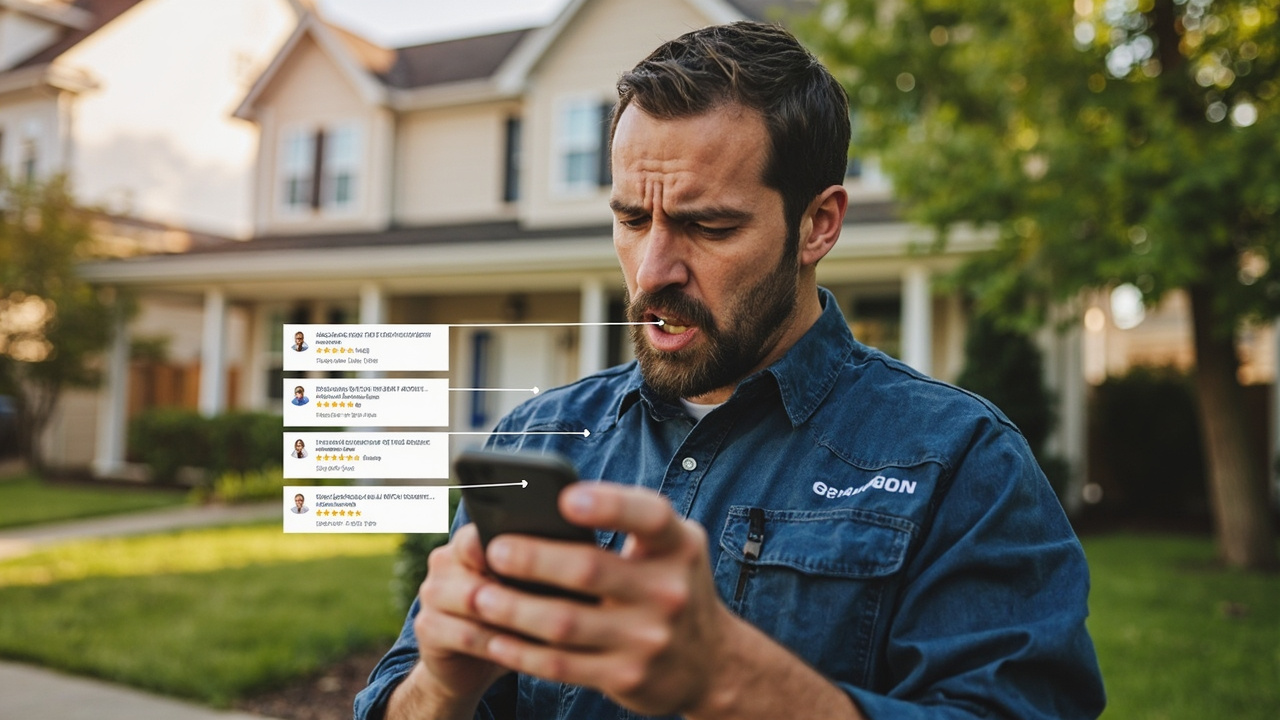
You check your phone on a Tuesday morning. Three new Google reviews appeared overnight. All 1-star. All from names you've never seen. None of these people have ever booked with your company.
Your first call is to Google. Your second call is to a lawyer. Your third call — the one that actually helps — might be the one you make after reading this article.
Fake review attacks on home service businesses are not rare edge cases anymore. They are a documented, growing, and financially devastating reality for HVAC contractors who have built their local reputation the right way. And the most important thing you need to know is simple: Google removes only about 20% of the fake reviews you report. That number is not a rumor. It comes directly from Google's own enforcement data.
The Scale of the Problem: 340% Increase in Fake Review Attacks
According to data compiled by HVAC audit firms, fake review attacks on HVAC and home service businesses have increased by approximately 340% since 2022. The targets are not random. Contractors with high ratings (4.5–5.0), strong local market positions, and active Google Business Profiles are the preferred targets — because their reputations represent a competitive threat.
The attack methods are varied but follow predictable patterns:
- Competitor blitzes: Rival companies coordinate mass 1-star reviews to damage a competitor's local ranking before a busy season.
- Disgruntled former employees: A terminated technician or office manager creates accounts to leave damaging reviews.
- Bot farms and gig-economy review services: Cheap, scalable services that produce fake reviews at volume for a fee — yes, this is a real business model.
- Review swap groups: Informal networks where contractors agree to review each other positively — but backfire when one party gets disgruntled.
The $14,000-a-Week Case: When a Fake Review Attack Becomes a Revenue Crisis
In one documented case, a Phoenix-based HVAC contractor woke up to find their Google rating had dropped from 4.8 to 3.9 after a coordinated overnight attack of fake 1-star reviews. Google removed only one of the seven fake reviews flagged for removal. The contractor's inbound lead volume dropped by an estimated 30% over the following week — representing approximately $14,000 in lost weekly revenue from jobs that simply did not come in.
The math is straightforward, even if it's uncomfortable: a half-point drop in your Google rating reduces click-through rates on your Business Profile, suppresses your Map Pack ranking, and — most damagingly — erodes the trust signal that gets homeowners to call you instead of your competitor.
If your average job value is $350 and you book 20 jobs per week from Google-generated leads, a 30% drop in inbound leads costs you roughly $2,100 in that week alone. Over a four-week attack period, that is $8,400 in lost revenue — before accounting for the longer-term ranking damage that can persist for months.
Why Google Only Removes 20% of Flagged Fake Reviews
Google's review removal process is automated, under-resourced, and — from the contractor's perspective — deeply frustrating. When you flag a review as fake, Google runs it through an automated system that evaluates:
- Whether the reviewer's account has a history of similar behavior
- Whether the review contains detectable spam patterns or templated language
- Whether the flagged content matches known violation patterns
The problem: sophisticated fake reviews are specifically written to avoid these automated checks. They use natural language. They give 1-star ratings with plausible-but-fabricated stories. They come from accounts that look legitimate on the surface. Google's system errs heavily on the side of keeping reviews — because its bias is toward free expression, not business protection.
For every five fake reviews you successfully identify and report, Google will remove approximately one. The other four stay on your profile, visible to every homeowner who is deciding whether to call you. This is not a technical failure Google is rushing to fix — it is a structural gap in their enforcement model that leaves legitimate businesses exposed.
The Mechanics of a Fake Review Attack
Understanding how these attacks work helps you recognize one faster — and respond more effectively. Here is the typical pattern:
Phase 1: Targeting
Your competitor or attacker identifies your strongest competitive asset: a 4.7+ Google rating and a dominant local Map Pack position. They recognize that damaging your rating weakens your ability to win the jobs that matter in your service area.
Phase 2: Execution
Reviews are posted from multiple accounts, often within 24–48 hours of each other. Each review tells a slightly different story — a bad installation, a missed appointment, an overcharge — to avoid looking coordinated. The language is designed to sound plausible to Google's automated systems.
Phase 3: Damage Assessment
By the time you notice, the damage is already compounding. Your rating has dropped. Your Map Pack ranking has slipped. Incoming call volume has softened. And Google is already telling you that your flagged reviews "do not violate our policies."
Phase 4: The Recovery Gap
Even after you successfully get fake reviews removed — or after enough time passes that they naturally fall off — your rating recovery is slow. Google's rating algorithms weight recency, so replacing five 1-star fake reviews with five genuine 5-star reviews takes time you may not have during peak season.
Rating drops from 4.8 → 3.9. Map Pack ranking falls 2–4 positions. Inbound lead volume drops 20–40%. You spend hours filing reports and appealing to Google. Most fake reviews stay.
You have a review velocity advantage: 3–5 new genuine reviews per week from real customers. A fake attack dilutes into background noise. Google's algorithm sees sustained authentic engagement. Recovery is fast or unnecessary.
The FTC Enforcement Tool Most Contractors Don't Know About
Here is the lever that is real, underused, and actually works: the Federal Trade Commission's Consumer Review Fairness Act and its associated penalty structure.
Under the FTC's rules, fake reviews — including paid or incentivized fake reviews — can carry civil penalties of up to $53,088 per violation. The FTC issued its first enforcement warning letters in December 2025. This is not a hypothetical future threat. It is an active enforcement mechanism that has started to be deployed.
For HVAC contractors, this means two things:
- If a competitor is paying for or coordinating fake reviews against your business: you may have grounds for an FTC complaint that carries real weight, especially if you can document a pattern.
- If you have ever participated in a review swap, paid for reviews, or offered incentives in exchange for reviews: you are not just risking a Google policy violation — you are risking an FTC enforcement action.
Unlike Google's enforcement (which focuses on account-level policy violations), the FTC enforcement operates independently and carries actual financial penalties. The FTC's first 10 warning letters went out in December 2025. The agency has made clear it is actively investigating fake review markets, especially in home services. This is a real hammer that Google cannot provide.
Your Fake Review Defense Playbook
The goal is not to react to attacks — it is to build a review profile so strong that individual fake reviews become irrelevant. Here is the framework we recommend to every Kortex360 client, applied specifically for the fake review threat:
-
Set up Google Alerts and review monitoring: Use Google Business Profile notifications, SEMrush or蒲团 review trackers, and a team member assigned to check reviews daily. The faster you spot a fake review, the faster you can document and report it before it damages your rating algorithms.
-
Document everything immediately: Screenshot the fake review, note the reviewer's profile information, record the date and time it appeared, and document that the reviewer has never been a customer. This documentation is critical if you pursue an FTC complaint or legal action.
-
Report through Google's official channel with precision: Flag each review individually through your Google Business Profile. Select the most specific violation reason available. Add a written explanation of why the review is fake — specifically noting that the reviewer has never been a customer of your business. Do this for every single fake review.
-
File an FTC complaint if the pattern is clear: If you can identify that reviews are coordinated, paid, or coming from the same source — especially if you have a suspected competitor — file a complaint at reportfraud.ftc.gov. Document your evidence carefully. The FTC has finite resources but active interest in this area.
-
Accelerate genuine review velocity to create a defensive buffer: This is the most underappreciated part of the playbook. If you have 50 genuine 5-star reviews and someone posts 5 fake 1-star reviews, your rating barely moves. Build a systematic, automated review generation process that makes earning real reviews from every real customer effortless and consistent.
Building Review Velocity: The Structural Defense That Makes Fake Reviews Irrelevant
The contractors who weather fake review attacks best are not the ones with the best lawyers or the fastest Google appeals. They are the ones with so many genuine 5-star reviews that a coordinated attack cannot move the needle on their rating.
Building that review velocity requires a systematic approach — not hope, not asking satisfied customers in passing, and not relying on the 1-in-10 customer who is motivated enough to leave a review unprompted. It requires:
- A trigger that asks every customer for a review immediately after job completion — when the experience is fresh and the emotional connection is strongest
- A two-step process: first, a simple 5-star review request (low friction), followed by an optional detailed review for highly satisfied customers
- Multiple submission channels: direct link, QR code on the invoice, SMS follow-up
- Monitoring and response to every genuine review — positive and negative — to demonstrate active engagement
"Your Google rating is not just a reputation metric. It is a competitive moat. Every genuine 5-star review you earn is a brick in that moat. The question is whether you are actively building it — or leaving it to chance while your competitors attack it."— Benjamin Orlof, Co-Founder & CEO, Kortex360
What Kortex360 Builds for Your Review Defense
For Kortex360 clients, review protection is not an afterthought — it is a system. Our review generation framework is built around three principles that directly counter the fake review threat:
First:覆盖率. We build the automated review request process so that every completed job triggers a review request. No exceptions. No "I'll ask them next time." The system runs whether your office is busy or slow, and it generates a consistent stream of genuine 5-star reviews that builds your rating and your defensive buffer.
Second: Speed. The review request goes out within minutes of job completion — not hours later, not the next day. Speed matters because the customer's emotional connection to a job done well is highest immediately after completion. Fast requests generate reviews at 3–5x the rate of delayed requests.
Third: Monitoring. We help you set up the review monitoring and response infrastructure so that fake reviews are spotted within hours — not days — and the documentation process begins immediately. Fast detection is the difference between a manageable incident and a ratings crisis.
The contractors who work with Kortex360 on review generation are not worried about fake reviews from competitors. They have a systematic advantage: a living, breathing review profile that is continuously reinforced by real customer experiences, making coordinated attacks a rounding error rather than a crisis.
- Fake review attacks on HVAC businesses have increased 340% since 2022 and are a documented, growing threat
- Google removes only approximately 20% of flagged fake reviews — leaving 80% to damage your profile
- A documented case showed $14,000 in weekly revenue loss from a single coordinated fake review attack
- The FTC is actively enforcing against fake reviews with penalties up to $53,088 per violation — this is a real lever
- The most effective long-term defense is genuine review velocity: building so many real 5-star reviews that fake attacks cannot move your rating
- Kortex360's review generation system creates systematic, automated coverage that protects your rating year-round
Stop Losing Jobs to Review Attacks and Fake 1-Stars
If your Google rating is vulnerable to attack, or if you are not systematically generating genuine reviews from every completed job, talk to the Kortex360 team. We will show you exactly how our review generation system builds a defensive moat around your reputation — and your revenue.
Protect My Reviews